


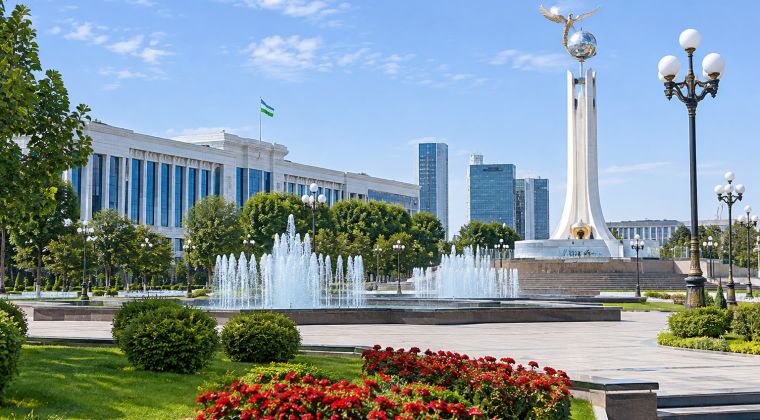
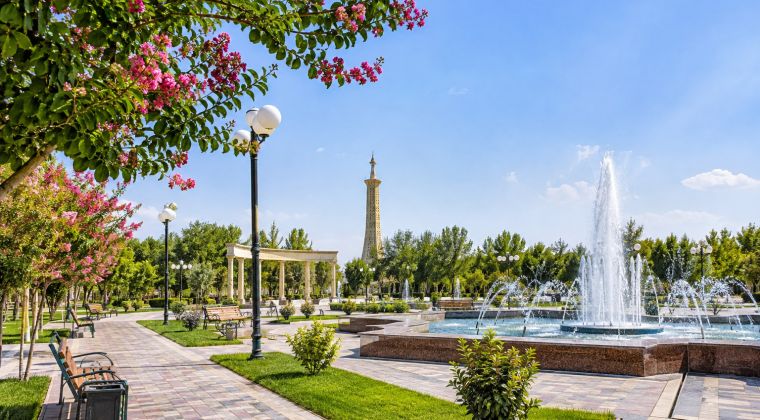
Discover Uzbekistan — a land of ancient cities, majestic architecture, Eastern bazaars and a rich cultural heritage. Over nine days you will get acquainted with the centuries-old history of Tashkent, see the unique archaeological monuments of Karakalpakstan, stroll along the old streets of Khiva and Bukhara, discover the traditional pottery art of Gijduvan and find yourself in legendary Samarkand, one of the main centers of the Great Silk Road.
Themes: Cultural, Historical, Archaelogical, Adventure, Gastronomical tours, Religious ,
Discover Uzbekistan — a land of ancient cities, majestic architecture, Eastern bazaars and a rich cultural heritage. Over nine days you will get acquainted with the centuries-old history of Tashkent, see the unique archaeological monuments of Karakalpakstan, stroll along the old streets of Khiva and Bukhara, discover the traditional pottery art of Gijduvan and find yourself in legendary Samarkand, one of the main centers of the Great Silk Road.
The itinerary combines visits to historical sights, museums, trips through picturesque landscapes and immersion in the everyday life of local residents. You can look forward to national cuisine, old craft workshops and the unique atmosphere of Eastern hospitality.
Arrival in Uzbekistan and introduction to the capital
Upon arrival at Tashkent International Airport you will be met by a representative of the host company with a name sign. After the meeting, a transfer to the hotel will take place. Early check-in is arranged so that you can rest after the flight and regain your strength before the busy sightseeing program.
After breakfast, your acquaintance with Tashkent begins — a modern metropolis in which historical heritage, Eastern traditions and the dynamic rhythm of modern life are harmoniously combined.
The tour will begin with a visit to the Hast-Imam complex, one of the most important spiritual centers of Uzbekistan. Here are located old mosques, madrasas and mausoleums that preserve the memory of outstanding religious figures. The complex is known for its architecture and unique manuscript treasures.
Next you will go to the Chorsu bazaar, one of the most colorful markets of the capital. Under its traditional dome are displayed fresh fruit, dried fruit, spices, Eastern sweets, national products and a variety of goods by local craftsmen. Here you can feel the true atmosphere of an Eastern trading city.
During the walk, the Kukeldash madrasa and the Juma mosque will also be viewed from the outside. Then the route will continue with a visit to the Museum of Applied Arts, which holds examples of the traditional crafts of Uzbekistan: embroidery, ceramics, woodcarving, jewelry and national decorative items.
The next part of the tour will introduce you to the central sights of the city. You will see Independence Square, the palace of Prince Romanov and Amir Temur Square, one of Tashkent's landmark public spaces. The introduction to the capital will conclude with a ride on the Tashkent metro, whose stations are distinguished by their original design and artistic decor.
After the sightseeing program, lunch and dinner are provided.
Overnight at a hotel in Tashkent.
Ancient fortresses of Karakalpakstan and the architectural heritage of Khorezm
Early in the morning a packed breakfast will be prepared for you, after which a transfer to the airport will take place for the flight to Nukus.
Upon arrival, your acquaintance with Nukus begins — the capital of the Republic of Karakalpakstan, located in northwestern Uzbekistan. The main cultural attraction of the city will be the I. V. Savitsky State Art Museum. Its collection is considered one of the most significant in Central Asia and includes works of Russian and Uzbek avant-garde, folk art items and archaeological finds.
After visiting the museum, the route will continue with a journey through the territory of ancient Khorezm. For many centuries this region was an important center of trade, culture and civilization. Today the ruins of fortresses that once protected ancient settlements and served as administrative and military centers have been preserved here.
The program includes a visit to the archaeological monuments of Ellik-Kala, a complex of ancient fortresses located amid desert and semi-desert landscapes.
You will see:
During the tour, lunch is provided in the area of Lake Akchakul. It is an opportunity to rest after visiting the archaeological monuments and enjoy the calm atmosphere of the local nature.
After the program is completed, the transfer to Khiva will take place — one of the best-preserved historic cities of Central Asia. Upon arrival you will check in at the hotel, have dinner and rest.
Overnight at a hotel in Khiva.
Ichan-Kala — a journey into the atmosphere of the medieval East
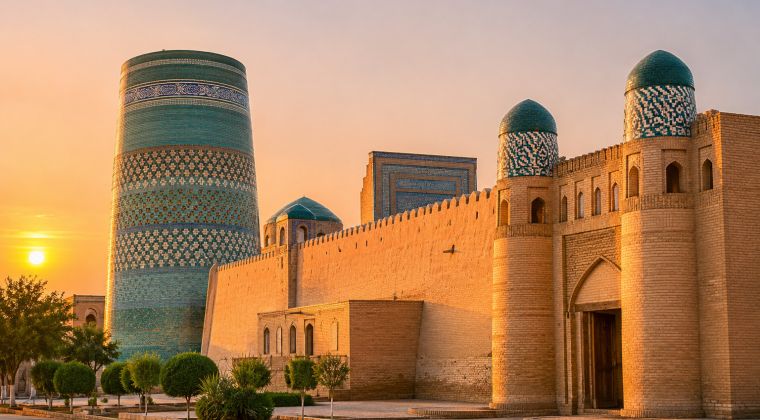
This day is entirely devoted to getting to know Khiva — a city that seems to have preserved the look of a medieval Eastern state. Its historic center, Ichan-Kala, is included in the UNESCO World Heritage List and is a unique architectural ensemble with fortress walls, minarets, madrasas, mosques and old residential quarters.
The tour will begin with a visit to the Muhammad Amin Khan madrasa, one of the largest religious educational institutions in Khiva. Nearby is the famous Kalta-Minor minaret, which attracts attention with its bright majolica finish and unusual massive shape. It was conceived as the tallest structure in the city, but construction was never completed.
Next you will get acquainted with the Kunya-Ark fortress, the former residence of the Khivan rulers. Behind its walls were palace rooms, reception halls, mosques and other buildings connected with the state life of the khanate.
The route will continue with a visit to the Muhammad Rahim Khan madrasa, and then the Juma Mosque, famous for its unusual interior. Its space is supported by 218 wooden columns, many of which are decorated with artful carving.
You will also see the Islam Khoja madrasa and minaret, one of the most recognizable architectural symbols of Khiva. Its history is connected with an era of significant transformations in the life of the city.
Then the route will lead to the Allakuli Khan complex, the old caravanserai and the mausoleum of Pahlavan Mahmud. The latter is dedicated to an outstanding poet, philosopher and wrestler, who is considered one of the most revered historical figures of Khiva.
The program also includes a visit to the Shergazi Khan madrasa and the Tash-Hauli palace. Special attention will be paid to the palace harem, whose inner rooms are decorated with traditional carving, ornaments and decorative ceramics. Tash-Hauli makes it possible to see how the daily life and court life of the Khivan rulers were organized.
After the tour you will have free time for an independent walk along the old streets, buying souvenirs and getting acquainted with local craft shops.
Overnight at a hotel in Khiva.
Across the Kyzylkum desert to one of the oldest cities of the East.
After breakfast you will set off for Bukhara — a city with a history of more than two thousand years, which for centuries was an important center of science, religion, trade and crafts.
The distance between Khiva and Bukhara is about 450 km. The travel time is approximately 7–8 hours.
The route will pass through the Kyzylkum desert, one of the largest desert regions of Central Asia. Along the way, the characteristic landscapes of the region will open before you: sandy expanses, sparse vegetation and boundless horizons. The journey will let you see another side of Uzbekistan — not only its famous cities, but also the harsh beauty of nature.
Stops are planned along the way for rest, a coffee break and lunch.
Upon arrival in Bukhara, check-in at the hotel will take place. After a short rest you will go for a walk through the historic center of the city.
One of the main points on the route will be the Lyabi-Hauz ensemble, a picturesque square around an old pond, surrounded by madrasas, a khanaka, cozy cafés and traditional buildings. It is one of the most atmospheric places in Bukhara, where the unhurried rhythm of the old city is felt especially well.
In the evening, dinner awaits you in a traditional local home. During the meeting you will be able to get acquainted with the features of Uzbek hospitality and take part in a master class on preparing plov, one of the main dishes of the national cuisine.
Overnight at a hotel in Bukhara.
After breakfast you will continue getting to know Bukhara — a city that for centuries was one of the most important centers of the Great Silk Road. Its historical monuments reflect the wealth of the architectural traditions and spiritual heritage of the region.
The first site will be the Chashma-Ayub mausoleum, whose name translates as “Job's Spring.” According to local legends, the story of the prophet Ayub is connected with this place. The structure stands out for its unusual architecture and characteristic dome.
Then you will visit the mausoleum of Ismail Samani, one of the outstanding monuments of early Islamic architecture in Central Asia. Built of baked brick, it is known for its intricate decorative brickwork, geometric patterns and harmonious proportions.
Next, the program will continue with a visit to the memorial complex of Bahauddin Naqshband, an important spiritual center connected with the history of the Naqshbandi Sufi order. Every year this place attracts pilgrims and travelers interested in the religious history of the region.
After this you will go to the country residence of the Bukharan emirs — the Sitorai Mohi-Hosa palace. Its name translates as “The Palace Like Stars and the Moon.” The architectural ensemble combines Eastern decorative traditions with elements of European design. The palace interiors are decorated with painting, carving, mirrors and exquisite ornaments.
In the second half of the day, a trip to Gijduvan will take place, located about 50 km from Bukhara. This town is known for its centuries-old traditions of ceramic production. Gijduvan masters preserve a special technique of making and painting ceramics, passing the secrets of the craft from generation to generation.
Here lunch awaits you in a local home and an introduction to traditional pottery art. You will be able to see how ceramic items are created, learn about the features of local ornaments and become acquainted with the work of the craftsmen.
After the tour, return to Bukhara.
Dinner and overnight at a hotel in Bukhara.
After breakfast, the tour of the historic part of Bukhara continues. The program will let you get to know more deeply a city that in different eras was the capital of powerful states and one of the largest intellectual centers of the Islamic world.
You will visit the Ark fortress, an ancient citadel that served as the residence of the Bukharan rulers. Behind its massive walls, palaces, administrative rooms and residential buildings stood for many centuries.
Then the route will continue at the Bolo-Hauz mosque, known for its graceful wooden columns and beautifully decorated iwan. After this you will stroll through a traditional bazaar, where local products, souvenirs, items by folk craftsmen and goods for everyday life are on display.
During the tour you will also visit the Lyabi-Hauz ensemble, the Nadir Divan-Begi madrasa, the khanaka and the Kukeldash madrasa. These structures form one of the most expressive architectural complexes of old Bukhara.
A special place in the program is occupied by the madrasas of Ulugbek and Abdulaziz Khan, monuments demonstrating the development of architecture and decorative art in different historical periods.
Next you will see Bukhara's famous trading domes. In the past, under their vaults were the shops of jewelers, money changers, and merchants of fabrics and other goods. Today these structures recall the time when the city was an important point of international trade.
The tour will conclude with a visit to the Magoki-Attori mosque and the Poi-Kalyan architectural ensemble, which is considered one of the main symbols of Bukhara. Its majestic minaret, mosque and madrasa create an impressive architectural ensemble that forms the unique look of the historic center.
After lunch, a transfer to the railway station will take place, with departure for Samarkand on the high-speed “Afrosiyob” train.
Upon arrival you will be met and taken to the hotel.
Overnight at a hotel in Samarkand.
Today an introduction to Samarkand awaits you — one of the best-known historic cities of Central Asia. For centuries it was an important trade, scientific and cultural center of the Great Silk Road. The city experienced a special flourishing in the time of Amir Temur and his descendants.
The tour will begin with a visit to the Gur-Emir mausoleum, the resting place of Amir Temur and members of the Timurid dynasty. The interior of the mausoleum amazes with the richness of its decoration: here you can see exquisite ornaments, gilding and artful finishing.
Then an exterior viewing of the Rukhabad mausoleum is planned, a historic structure located not far from Gur-Emir.
The main event of the day will be a visit to Registan Square, the famous architectural ensemble that is rightfully considered the calling card of Samarkand. The square is formed by three majestic madrasas:
The Ulugbek madrasa — one of the most important educational structures of the Timurid era, connected with the development of science and astronomy.
The Sherdor madrasa — an architectural monument known for its expressive façade and unusual images on its portal.
The Tilla-Kari madrasa — a structure famous for its luxurious interior decoration and abundance of gold decor.
After Registan you will go to the Bibi-Khanum mosque, one of the largest religious structures of medieval Samarkand. Its majestic portals and domes bear witness to the power of the state of Amir Temur.
Next, an exterior viewing of the Hazrati Khizr complex is planned, located on a hill and connected with the spiritual history of the city.
The sightseeing program will conclude with a visit to the Siab Bazaar. It is one of the best-known markets of Samarkand, where you can get acquainted with local products, buy traditional sweets, dried fruits, spices, the famous Samarkand flatbreads and souvenirs.
Overnight at a hotel in Samarkand.
After breakfast, the sightseeing program will continue with an introduction to the cultural and scientific heritage of Samarkand.
First you will visit a workshop producing traditional paper and silk. Here you will be able to learn about the old technologies of making paper and processing natural materials that local masters used for centuries. Visiting the workshop will let you see how craft traditions are preserved today.
Next you will go to the Ulugbek Observatory, one of the most important scientific monuments of the medieval East. In the 15th century Samarkand became a major center of astronomical research thanks to the activity of the ruler and scholar Mirzo Ulugbek. Parts of a unique astronomical instrument that was used to observe celestial bodies have been preserved here.
Nearby is the Ulugbek museum, whose exhibition introduces the scientific achievements of his era, the history of the observatory and the development of astronomy in Central Asia.
The next stop will be the mausoleum of Saint Daniel, a revered place connected with religious traditions. It has special significance for representatives of different faiths and is considered one of the unusual spiritual sites of Samarkand.
Then you will visit the Afrasiab museum, dedicated to the history of ancient Samarkand. Its exhibition tells about the life of the city before the Mongol conquest and the development of trade, culture and art. Of particular interest are the archaeological finds and the famous Afrasiab frescoes.
After the museum, the program will continue with a visit to the Shah-i-Zinda necropolis, one of the most impressive architectural ensembles of Uzbekistan. The complex is a series of mausoleums decorated with bright mosaics, majolica and exquisite ornaments. A walk through its grounds will let you see the variety of architectural styles and decorative techniques characteristic of different historical eras.
After lunch you will have free time. It can be devoted to an independent walk around Samarkand, visits to souvenir shops or rest at the hotel.
Overnight at a hotel in Samarkand.
After breakfast you will have time to prepare for departure and pack your things. After check-out, a transfer to Samarkand airport will take place to check in for the international flight.
This concludes your journey through Uzbekistan — a country where the history of the Great Silk Road continues to live on in ancient cities, architectural monuments, traditional crafts and the hospitality of local residents.


