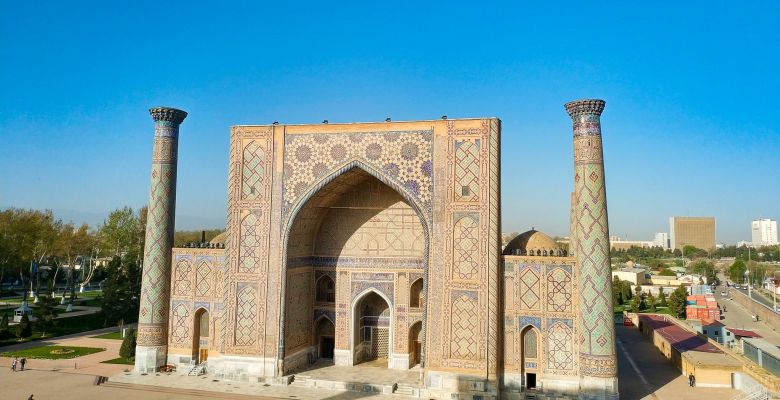
Ulugbek Madrasah (Ulug`bek madrasasi) is a Muslim spiritual and educational, educational and religious building of the 15th century in Samarkand. The oldest madrasah of the architectural ensemble of Registan Square, erected by the ruler of the Timurid state and scientist-astronomer Ulugbek. Together with the Sherdor and Tilla-Kari Madrasahs, it forms an integral architectural ensemble. In 2001, among other attractions of Samarkand, it was inscribed on the UNESCO World Heritage List. Ulugbek Madrasah was built according to the Muslim canon in full accordance with the requirements of its era.
It is a classic example of a religious educational institution in Central Asia and the Middle East.
The madrasah was built in 1417-1420. In artistic terms, it was not inferior to the buildings of Temur and at the same time significantly surpassed them in their strength.Initially, the madrasah consisted of 50 hujras and trained more than a hundred students a year. According to the historians, Ulugbek himself taught in the madrasah. A prominent Persian poet, Jami, also lived and worked here. Among the most famous listeners of Jami in madrasah were Sheikh of Nakshbandi order - Khoja Akhror Vali and the great poet Alisher Navoi.The building had 2 floors, four high domes over the corner auditoriums and four minarets at the corners. The giant portal, which occupies two-thirds of the main facade, faces the square with a huge and deep pointed arch.Ulugbek madrassah suffered quite a lot during internecine wars in the XVIII century. The outer domes and most of the rooms on the second floor were destroyed.
The madrassah was built in the classical oriental style, richly decorated with majolica tiles, colored mosaic, carved marble, and carved verses from the Holy Quran, hadiths and other wise sayings on the walls. A peculiarity of the madrasah's ornament, which distinguished it from the others, was stellar theme with astral notes, which is not surprising, because Ulugbek was famous for its extensive knowledge of astronomy.
Unfortunately, the ecclesiastical educational institution has not survived till our days in its original form; the blue domes and hujras were destroyed, the walls were shaken and the building became dilapidated. At the end of the 20th century, restoration work was carried out, the portal and minarets were rebuilt, huge work was done to restore the former appearance.