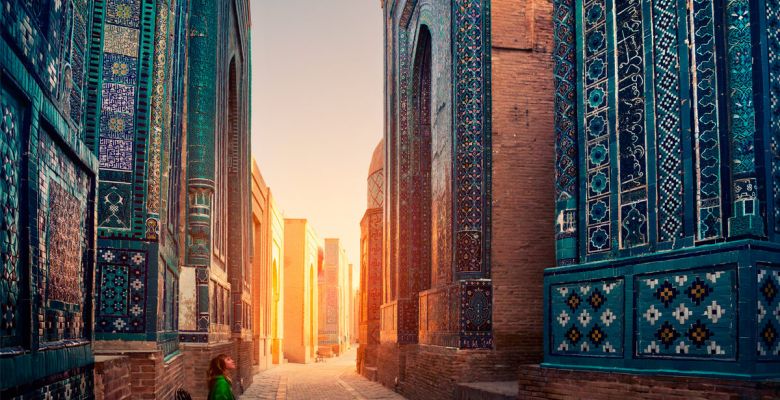
The Shakh-I-Zinda Ensemble is one of the world-known necropolises of Central Asia, which includes mausoleums and other ritual buildings of 9-14th and 19th centuries. It is situated in the northeastern part of Samarkand. The name Shakh-I-Zinda - "The living king" is connected with the legend that Kusam ibn Abbas, the cousin of the prophet Muhammad was buried there. As if he came to Samarkand with the Arabian invasion in the 7th century to preach Islam. Popular legends speak that he was beheaded for his faith. But he took his head and went into the deep well (Garden of Paradise), where he's still living now.
Extant complex consists of eleven mausoleums, is attached in series to each other during the XIV-XV centuries. However, in the course of excavations on the eastern slope of the ancient Afrasiab discovered the remains of the mausoleums XI-XII centuries. In 2001 the ensemble of Shahi Zinda mausoleums, along with other ancient buildings of Samarkand is included in the UNESCO World Heritage List.
There are mausoleums of 10 people in Shakhi Zinda:
- Kusam ibn Abbas - the first and the main mausoleum
- Turkan-aka - a memorial in honor of the youngest wife of Amir Temur
- Emir-zade - on the site of the mausoleum there was a building for worship
- Two-dome mausoleum - in honor of Amir Temur's breastfeeding nurse Uldzh-Inaga and her daughter
- Khoja-Akhmad - only the portal survived to this day
- Tuglu-Tekin - the daughter of Emir Khoja
- Octagon - octagonal pavilion
- Emir Burunduk - a devoted military leader of Amir Temur
- Shady-Mulk-aka - the mausoleum of Timur's niece
- Mausoleum of a noble lady - a girl that died sinless
The oldest buildings of the ensemble, from which only the base and preserved tombs date back to XI-XII centuries. The vast majority of the buildings belong to the XIV-XV century, and the restructuring of XVI-XIX centuries virtually no effect on the composition and appearance of the complex.
Shahi Zinda - the only one in Samarkand, archeological and architectural monument, which, including the cultural layers of Afrasiab, affected nearly three thousand years history of the city.
Center of the whole ensemble is complex of Kusam ibn-Abbas, which includes several buildings, among which the most ancient - the mausoleum Kusam ibn-Abbas and Mosque by the XVI century. The complex has a door with the date 1404-1405. Decorated with carvings and original inlaid with ivory.
There is a complex on the left which consists of mausoleum, mosque and hujr. It was built at the beginning of the XV century. The middle group consists of mausoleums built at the beginning of the XIV and at the end of the XV centuries. All buildings have the connection with Tamerlan’s relatives. There is a mausoleum Shadi-Mulk-aga on the west side. She was Tamerlan’s nephew. The construction is a portal-dome, single-chamber crypt, built in 1372. On the contrary there is the mausoleum of Timur’s sister – Shirin-Bika-aga. The lower group is the most proportional with two domes building, located at a multy-stage ladder. The mausoleum was built at the beginning of the XV century.
Shakhi Zinda architectural ensemble amazes with an abundance of various paints, ornaments, patterns, carving techniques, proving the skill of hundreds of craftsmen who worked on this beauty. It is impossible to imagine how many hands and minds have created this sacred place of artistic, historical and cultural value of the whole Central Asia, which has survived to our days, so that we, the descendants, could honor the memory of our ancestors, know and remember their achievements, respect the history of our nation.