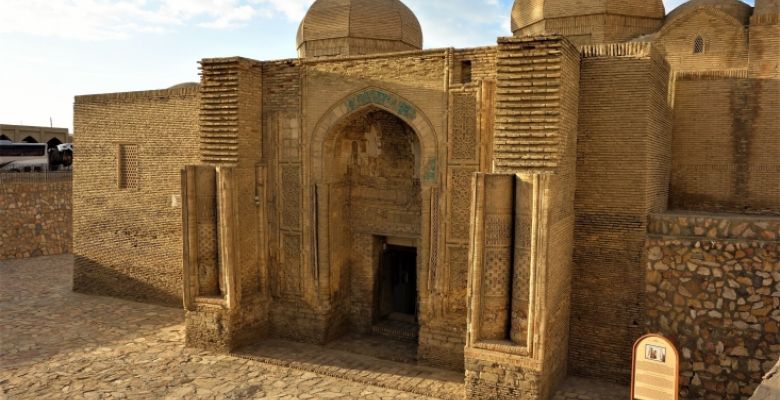
The most ancient preserved Bukhara mosque Magoki Attari (in translation means “the mosque in the pit”, “deep mosque”) is situated in the center of the city, near tire Lyabi Hauz complex. Before the Arabian conquest, trade market for spices and herbs sellers (the attars) was in established at the site of the mosque. The Magoki Attari Mosque is attributed to the type of so-called closed mosques, with the ceiling on six stone pillars.from historical sources that in place Magoki Attori before Islam was a market where trading idols, medicinal potions and herbs. Such traders are called "Attoron", the word "Magoki" means "the pit, a deep place." There is the Temple of the Moon. Most likely, this temple was a place of worship of "Sin" - God of the Moon. In Mesopotamia, there were two major centers of the cult: Ur in the south and Harran in the north. Rooting worship in Bukhara likely refers to the ancient period, when Babylon and Assyria had a strong influence on the development of this region. Moon was the patron god of nomadic peoples, as the moon lit their way during the night wanderings. Therefore, it is also possible that this cult has been adapted by local nomads with the introduction of some local features.
In XVI c. Abdulaziz Khan I undertook major repairs of the mosque, which was completed in 1549 then there is a new eastern (upper) portal, because the ancient southern portal of the was under multimeter layer of cultural deposits. Now the southern façade is fully released and restored.
The mosque is an architectural monument. It refers to a type of cl osed mosques, with the overlap of the six stone pillars. Of particular note is its southern portal - a work of art. The portal and entrance of the niche are decorated with polished masonry bricks, glazed majolica, carved alabaster and terracotta. From inside the east entrance to the very floor of the monument down the broad stone staircase. In addition to its direct purpose, it also serves as a place for prayer.
Another interesting fact in the life of this structure may serve as a fact that before the construction of the first Synagogue in Bukhara Jews prayed in the same room with the Muslims. This premise is Magoki Attori.
Today in the building of mosque houses a Museum of carpets. Here are copies of the masters of carpet weaving in Azerbaijan, Turkmenistan, China, Uzbekistan and other countries.
This architectural monument is one of the most ancient witnesses to the long history of Bukhara. Until now, scientists have not finished studying it. And the fact that it has been found in the St. Petersburg Hermitage.