


We invite you to set off on a great journey through Uzbekistan — a country where ancient civilizations have left behind majestic architectural monuments, Eastern cities have preserved the atmosphere of the Great Silk Road, and traditional crafts continue to live thanks to the skill of local residents.
Themes: Cultural, Historical, Archaelogical, Adventure, Gastronomical tours, Religious ,
We invite you to set off on a great journey through Uzbekistan — a country where ancient civilizations have left behind majestic architectural monuments, Eastern cities have preserved the atmosphere of the Great Silk Road, and traditional crafts continue to live thanks to the skill of local residents.
Over 14 days you will get acquainted with the most varied regions of the country: from the lively capital and the fertile Fergana Valley to the harsh landscapes of Karakalpakstan, the mysterious fortresses of ancient Khorezm and the legendary cities of Samarkand, Bukhara and Khiva.
You can look forward to palaces of Eastern rulers, old madrasas, mosques with artful mosaics, archaeological monuments, craft workshops and colorful bazaars. You will see how the famous Rishtan ceramics and Margilan silk are made, become acquainted with traditional Karakalpak life and taste dishes of the national cuisine.
A special place in the program is occupied by meetings with local masters, culinary demonstrations and folklore performances. This journey will let you not just visit famous sights, but also feel the true character of Uzbekistan — hospitable, distinctive and remarkably multifaceted.
The journey will begin with arrival in Tashkent — the dynamic capital of Uzbekistan, in which modern city life is harmoniously combined with Eastern traditions and centuries-old history.
You will arrive at Tashkent International Airport. After passing passport and customs control you will be met by a representative of the host company with a name sign. Next, a transfer to the hotel, check-in and rest are provided. A full night's accommodation is included in the price of the program.
Closer to midday, a sightseeing tour of the capital will begin. The first stop will be the Hazrati Imam spiritual complex — one of the most important religious and historical ensembles of the city. On its territory are the Kaffal Shashi mausoleum, the Barak Khan madrasa and the Tilla-Sheikh mosque.
You will also see the Center of Islamic Civilization, impressive in its scale and architectural appearance.
Then you will go to the Chorsu bazaar — one of the best-known Eastern markets of Tashkent. Under its domes are trading rows with aromatic spices, dried fruits, nuts, fresh produce, national sweets and items by craftsmen. Here the atmosphere of a traditional Eastern city is felt especially vividly.
The introduction to the capital will continue with a ride on the Tashkent metro. Each station is distinguished by its own design, decorative elements and architectural solutions.
The program will conclude with a visit to the Museum of Applied Arts, whose exhibition presents traditional ceramics, embroidery, woodcarving, jewelry and national fabrics.
Overnight in Tashkent.
After breakfast you will set off to meet new discoveries — to the Fergana Valley, known for its ancient cities, fertile lands and craft traditions.
A transfer to the railway station is provided.
Kokand is a city with a rich historical past, which in the 18th–19th centuries was the capital of the Kokand Khanate. At that time the residence of the rulers was located here, and trade, education, architecture and craft production developed.
During the tour you will visit the palace of Khudayar Khan — one of the main architectural sights of the city. This is the former residence of the Kokand rulers, amazing in its scale, decorative façades and traditional Eastern ornaments. Today the building houses a museum dedicated to the history of the khanate.
The program also includes the Modari Khan mausoleum, the Dakhma-i-Shokhon memorial complex, the historic Friday mosque and the Norbuta-bi madrasa. Each of these monuments reveals a separate page of the religious and cultural history of Kokand.
During the tour, lunch is provided at a local restaurant.
After getting acquainted with the city, the route will continue to Rishtan — a well-known center of Uzbek pottery art. Then you will set off on a road that will take approximately one hour.
Here a visit awaits you to the workshop of the famous ceramist Rustam Usmanov. You will become acquainted with the process of creating traditional Rishtan tableware, the features of hand painting and the secrets of making the natural glaze “ishkor.” This old technology gives the items their characteristic shades and unique shine.
Next, the trip continues to Fergana. Upon arrival — check-in at the hotel, free time and dinner.
Overnight in Fergana.
The morning will begin with a tour of Fergana — a city distinguished by spacious streets, green parks and architecture with characteristic features of the colonial period.
You will stroll through the city park and its surroundings, see historic buildings and visit the local history museum, which holds materials on the history, nature and cultural heritage of the region.
The next stop is Margilan, one of the best-known silk-producing centers of Central Asia. For many centuries the city was famed for the art of making fabrics, and its masters preserved unique technologies of hand weaving.
A visit to a silk factory and a Crafts Center awaits you. Here you will be able to become acquainted with the process of creating traditional fabrics — atlas and adras, learn about the methods of dyeing threads and the features of making the famous Uzbek patterns.
The tour will continue with the Pir Siddiq complex, the Khonakhan mosque and the local Margilan bazaar. The market will let you see the daily life of the city and become acquainted with the range of local goods.
After this you will go to Chust — a town that became known thanks to the traditional knife-making craft. Local masters pass down from generation to generation the skills of forging, metalworking and making handmade items.
Transfer to the Pap railway station.
Upon arrival in the capital — transfer to the hotel, check-in and rest.
Overnight in Tashkent.
After breakfast, check-out. Before the departure for Nukus, a continuation of the tour of Tashkent awaits you, devoted to modern architecture, history and landmark city spaces.
You will visit Independence Square — one of the main squares of the country, symbolizing the modern statehood of Uzbekistan.
Then you will see the palace of Prince Romanov, a historic building connected with the stay in Tashkent of a member of the Russian imperial family. The program also includes the Museum of Applied Arts, which holds works by traditional masters.
The route will continue with the Monument of Courage, dedicated to the events of the devastating 1966 earthquake and the rebuilding of the city.
You will also see the Alisher Navoi Bolshoi Theater, stroll through the popular pedestrian zone known as the local Broadway, and visit Amir Temur Square.
The tour will conclude with the memorial to the victims of repression, recalling the tragic pages of 20th-century history.
Transfer to the airport. Flight to Nukus.
Nukus is the administrative and cultural center of the Republic of Karakalpakstan, located in the northwest of the country. This region is distinguished by a distinctive culture, unique natural landscapes and a rich archaeological heritage.
Upon arrival, transfer to the hotel and check-in.
Overnight in Nukus.
Today is devoted to an introduction to the culture of Karakalpakstan — a region in which ancient craft traditions, distinctive decorative art and features of nomadic life have been preserved to this day.
After breakfast you will set off on a tour of Nukus. The main point of the program will be the Igor Savitsky State Art Museum — one of the best-known cultural institutions in Central Asia.
The museum became famous for its unique collection of works of Russian and Turkestan avant-garde. Here are presented works by artists whose creative work long remained little known to the general public. Besides the art collection, the museum holds archaeological and ethnographic materials that tell about the region's centuries-old history.
After visiting the museum you will go to Chimbay, located about 65 km from Nukus. The trip will take about an hour.
In the town, an introduction to the traditional way of life of the Karakalpak people awaits you. You will visit a yurt-making workshop and learn how the wooden frames are made and what materials are used to form the walls and covering of the traditional dwelling.
Special attention will be paid to the production of woolen carpets. You will become acquainted with the process of processing wool, hand weaving and creating national ornaments that reflect local residents' ideas about nature and the world around them.
After the tour, return to Nukus.
Overnight in Nukus.
After breakfast, check-out. Departure for the Ellikkala district — a territory known for its numerous archaeological monuments and the ruins of ancient Khorezmian cities.
The road will take about three hours. During the day you will see several fortresses that once protected settlements and served as important points of the ancient civilization.
The first stop will be Shilpyk-Kala — an ancient structure rising above the surrounding area. The monument is connected with the history of Zoroastrian burial traditions.
Then the route will continue to Toprak-Kala — the ruins of an ancient city that at the height of its flourishing was one of the political and cultural centers of Khorezm. Palace buildings, residential rooms and administrative structures were located here.
The next stop is Kyzyl-Kala, an ancient fortress that has preserved the characteristic features of the region's defensive architecture.
A special place in the program is occupied by Ayaz-Kala — a complex of fortress structures located on heights amid open desert spaces. The scale of the ruins and the surrounding landscapes create an impressive atmosphere of traveling in the footsteps of ancient history.
Along the route, a rest and tea break at a traditional yurt camp is provided.
After getting acquainted with the archaeological heritage you will go to Khiva — an ancient city of Khorezm, which for centuries was an important center of trade, crafts and culture.
Upon arrival — check-in at the hotel.
In the evening a national dinner and a folklore performance at a local restaurant await you. Music, dances and traditional costumes will let you become acquainted with the cultural heritage of Khorezm.
Overnight in Khiva.
Today you will fully immerse yourself in the atmosphere of ancient Khiva — one of the most recognizable historic cities of Uzbekistan.
After breakfast, a walking tour of Ichan-Kala will begin — the inner city surrounded by mighty fortress walls. This unique architectural ensemble is included in the UNESCO World Heritage List and is a true open-air museum.
The tour will begin with the Muhammad Amin Khan madrasa and the famous Kalta-Minor minaret, which stands out for its unusual width and bright turquoise tiling.
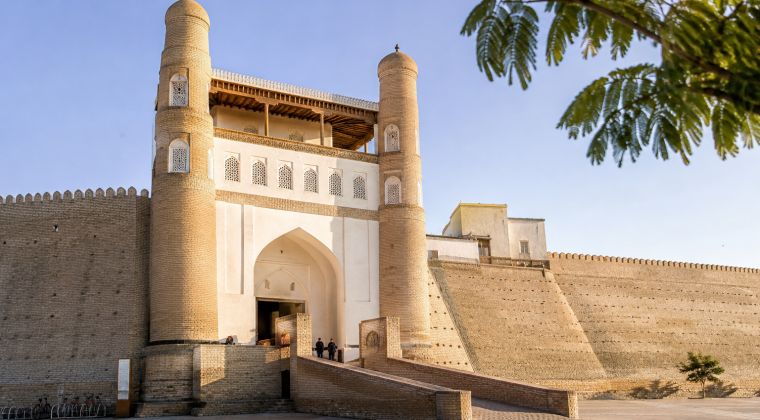
Then you will visit Kunya-Ark — an ancient citadel that served as the residence of the Khivan khans. On its territory were palace rooms, administrative buildings and inner courtyards.
Next an introduction awaits you to the madrasa of Muhammad Rahim Khan and the mausoleum of Pahlavan Mahmud — a revered poet, wrestler and spiritual patron of Khiva.
One of the most unusual sites will be the Juma Mosque, famous for the 218 carved wooden columns supporting its interior space.
The route will continue with the Islam Khoja minaret and madrasa, the Allakuli Khan madrasa and the old caravanserai, recalling the time when Khiva was an important point on the trade routes.
You will also visit the Tash-Hauli palace — the former residence of the city's rulers. Its inner courtyards, decorative elements, ceramic finishing and harem rooms demonstrate the richness of Khorezm's architectural heritage.
After the tour, free time is provided. You will be able to stroll independently along the narrow streets of Ichan-Kala, look into craft workshops, buy souvenirs and enjoy the atmosphere of the old city.
Overnight in Khiva.
Early breakfast. Transfer to the railway station.
Departure for Bukhara on the “Manguberdi” train.
Bukhara is one of the oldest cities of Central Asia, a historic center of Islamic culture, science and trade. For many centuries it received merchants, scholars and travelers who arrived here along the routes of the Great Silk Road.
Upon arrival, a walking tour of the old city will begin.
The first site will be the Lyabi-Hauz ensemble, which formed around an old pond. It includes the Nadir Divan-Begi madrasa, the khanaka of the same name and the Kukeldash madrasa. It is one of the most atmospheric places in Bukhara, where historic architecture is harmoniously combined with cozy pedestrian spaces.
Next you will see the Magoki-Attori mosque, which is considered one of the oldest religious structures in the city.
The program also includes a visit to the madrasas of Ulugbek and Abdulaziz Khan. These monuments demonstrate the skill of Eastern architects and the richness of decorative art.
Then you will go to the old trading domes of Bukhara. In the past, specialized markets were located under them, where jewelry, headwear, fabrics and other goods were sold.
You will become acquainted with the historic trading quarters of Sarafon, Telpak-Furushon, Zargaron and Abdullah Khan.
The tour will conclude with the Poi-Kalyan ensemble — one of the main symbols of Bukhara. It includes the majestic Kalyan minaret, the Kalyan mosque and the Mir-i-Arab madrasa. This complex remained for centuries the most important spiritual and architectural center of the city.
After the tour — transfer to the hotel, check-in and free time.
Overnight in Bukhara.
After breakfast you will continue getting to know the history and culture of Bukhara.
The first stop will be the Samanid mausoleum — an outstanding monument of early Islamic architecture. Its uniqueness lies in its artful brickwork, thanks to which complex geometric patterns and an expressive play of light and shadow are created.
Then you will visit the Chashma-Ayub mausoleum, whose name translates as “Job's Spring.” An ancient legend is connected with this place about the prophet who, according to tradition, struck the ground with his staff, after which a spring of water appeared.
The route will continue with the Bahauddin Naqshbandi complex — one of the most revered spiritual shrines of Uzbekistan. It is connected with the name of the founder of the Naqshbandi Sufi order and has remained a place of pilgrimage for many centuries. Here you will be able to become acquainted with the religious traditions and customs of local residents.
Next a visit awaits you to the country residence of the last Bukharan emirs — the Sitorai Mohi-Hosa palace. Its name translates as “The Palace Like Stars and the Moon.”
The architectural ensemble is interesting for its unusual combination of Eastern decor and European elements. In the decoration of the interiors, items brought from Russia and Europe were used. The palace was created as a luxurious residence of the ruling dynasty and a place for receiving high-ranking guests.
After the sightseeing program you will go to a national home, where lunch with a culinary demonstration and master class awaits you. You will see the process of preparing traditional Uzbek dishes and become acquainted with the features of the local gastronomic culture.
In the second half of the day, free time is provided at the Bukhara bazaars. It is an excellent opportunity to buy handmade items, traditional fabrics, ceramics, spices and memorable souvenirs.
To conclude the day, a folklore performance awaits you at the Nadir Divan-Begi madrasa. National melodies, dances and bright costumes will be a wonderful complement to your introduction to Bukhara.
Overnight in Bukhara.
After breakfast and check-out you will set off for Samarkand.
Along the way, a stop is planned in Gijduvan — a town long known for its pottery workshops and distinctive ceramics school.
You will visit the workshop of the Narzullaev family, where the traditions of making ceramics have been preserved for several generations. Here the masters continue to use old methods of processing clay, shaping, firing and hand painting.
Gijduvan ceramics are distinguished by expressive ornaments, characteristic color combinations and a recognizable style. During your visit you will be able to get to know the work of the craftsmen more closely and see how items that have become part of the region's cultural heritage are created.
After Gijduvan the route will continue with a visit to the Imam al-Bukhari complex — one of the most revered Islamic scholars and theologians. His collection of hadiths occupies a special place in the Sunni religious tradition, and the memorial complex is an important spiritual center.
Then you will continue on to Samarkand — a legendary city whose history spans more than two millennia. For centuries it was an important trade and cultural center, and under Amir Temur it turned into the capital of a powerful empire.
Upon arrival — transfer to the hotel and check-in.
Overnight in Samarkand.
Today an introduction to Samarkand awaits you — one of the most famous cities of the Great Silk Road. Its architectural monuments, rich history and cultural heritage have for centuries inspired travelers, poets and historians.
The tour will begin with a visit to the Gur-Emir mausoleum — the ancestral burial place of the Timurid dynasty. The burial of Amir Temur is located here. The majestic dome, exquisite finishing and rich interior decoration make the mausoleum one of the most impressive monuments of the era.
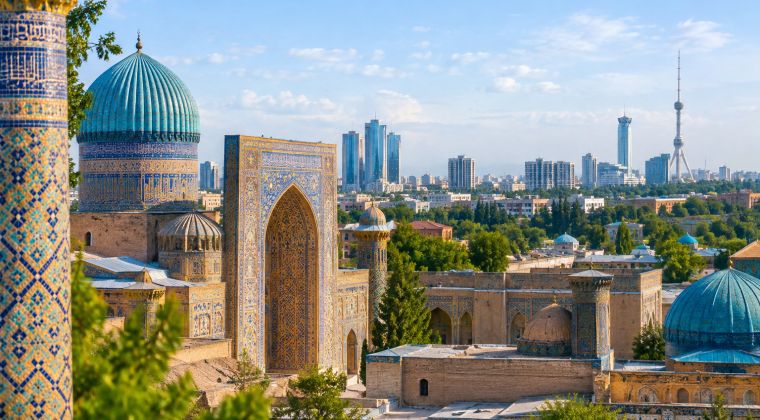
Next you will go to Registan Square — the architectural pearl of Samarkand. The ensemble is formed by three madrasas: Ulugbek, Sherdor and Tilla-Kari. Their façades are decorated with complex mosaics, majolica and traditional ornaments, creating the unique look of the square.
The next stop is the Bibi-Khanum mosque, a monumental structure built in the era of Amir Temur. In the past it was considered one of the largest mosques of the Islamic world.
Then you will visit the Siab Bazaar — one of the most colorful markets of the city. Here you can get acquainted with local products, taste traditional sweets, and buy dried fruits, nuts and the famous Samarkand flatbreads.
The tour will conclude with a visit to the Hazrati Khizr mosque — a historic religious monument connected with the spiritual legends of Samarkand.
After the tour, return to the hotel and free time.
In the evening, dinner awaits you in a national home with a demonstration of preparing a traditional dish. It is an opportunity to get acquainted with Uzbek cuisine not only through its flavors but also through the very process of preparation.
Overnight in Samarkand.
After breakfast you will set off for Shakhrisabz — the hometown of Amir Temur, located amid picturesque mountain landscapes.
The journey will pass through the Takhtakaracha pass. Along the way you will be able to enjoy views of mountains, valleys and the surrounding natural landscapes. The trip is made by sedan or minivan.
Shakhrisabz is known as one of the most important historical centers of the Timurid era. Monuments connected with the name of the great military commander and his dynasty have been preserved here.
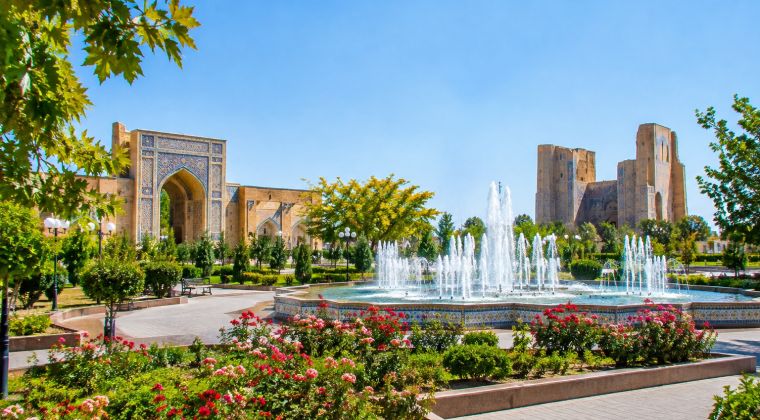
The first site of the tour will be the ruins of the Ak-Saray palace — a grand residence whose construction was begun by order of Amir Temur. The majestic entrance pylons have survived to this day, making it possible to imagine the original scale of the palace complex.
Next you will visit the Gumbazi Saidon mausoleum, which belongs to the historical architectural heritage of the city.
The route will continue with the Dorus-Saodat complex, which includes the Jahangir mausoleum and the Hazrati Imam mosque. This memorial ensemble is connected with the history of Amir Temur's family and occupies a special place among the monuments of Shakhrisabz.
The next stop is the Dorut-Tilyavat complex, which includes the Kok-Gumbaz mosque and the mausoleum of Sheikh Shamsiddin Kulyal. The architecture of the ensemble reflects the high level of development of religious architecture and decorative art in the region.
After the tour, return to Samarkand.
In the evening, free time is provided and a visit to one of the city's monuments in festive architectural illumination.
Overnight in Samarkand.
After breakfast, check-out and continuation of the sightseeing program in Samarkand.
The first stop will be the Shah-i-Zinda necropolis — one of the most beautiful architectural ensembles of the city. The complex consists of mausoleums decorated with exquisite mosaics, majolica and traditional ornaments. Its architecture lets you trace the development of decorative art over several centuries.
Then you will visit the Afrasiab museum, dedicated to the ancient history of Samarkand. Its exhibition presents archaeological finds and items from different historical eras. Of particular value are the frescoes of the 7th century, which preserve depictions of historical scenes and the daily life of the ancient city.
The route will continue with the mausoleum of Saint Daniel — a revered place that has spiritual significance for representatives of the three main world religions.
After this you will go to a workshop producing Samarkand silk paper. Here you will become acquainted with the technology of making paper by old methods known since the 9th century. The program also includes a visit to a traditional oil mill, where you can learn about the features of oil production.
The tour will conclude with the Ulugbek Observatory museum. In the 15th century Samarkand was one of the leading scientific centers of the East. The ruler and scholar Ulugbek made a significant contribution to the development of astronomy, and his observatory became an outstanding scientific structure of its time. In the museum you can see the surviving part of the original sextant used for astronomical observations.
After the tour, transfer to the railway station and departure for Tashkent on the high-speed “Afrosiyob” train.
The departure time depends on the schedule: 16:56, 17:40, 18:15 or 18:49.
Upon arrival in the capital — meeting, transfer to the hotel and check-in.
Overnight in Tashkent.
Breakfast.
A transfer to Tashkent International Airport is provided to check in for the return flight.
Your journey through Uzbekistan comes to an end — a country of ancient cities, remarkable architectural monuments, distinctive crafts and sincere Eastern hospitality.
Over two weeks you have become acquainted with different sides of the country: from the history of the khanates and the traditions of the Fergana Valley to the heritage of ancient Khorezm, the spiritual centers of Bukhara and the architectural splendor of Samarkand.


