


Discover multifaceted Uzbekistan — a country where ancient cities preserve the memory of great civilizations, desert expanses recall the days of the caravans of the Great Silk Road, and the traditions of hospitality are passed down from generation to generation.
Themes: Cultural, Historical, Archaelogical, Adventure, Gastronomical tours, Religious ,
Discover multifaceted Uzbekistan — a country where ancient cities preserve the memory of great civilizations, desert expanses recall the days of the caravans of the Great Silk Road, and the traditions of hospitality are passed down from generation to generation.
Over ten days you will travel from the medieval streets of Khiva to the majestic architectural ensembles of Bukhara and Samarkand, get acquainted with the ancient fortresses of Khorezm, visit craft workshops, see the picturesque landscapes of the Kyzylkum desert and spend a night in a traditional yurt camp by Lake Aydarkul.
You can look forward not only to historical tours, but also to the chance to touch the real life of the country: try your hand at preparing national plov and Uzbek bread, get acquainted with the art of pottery, see the process of making silk and Samarkand paper, and feel the atmosphere of nomadic culture.
Upon arrival at Urgench International Airport you will be met by a representative of the host company. After the introductions and help with your luggage, a transfer to Khiva will take place — one of the most distinctive historic cities of Uzbekistan. The drive takes about 45 minutes, and the distance is approximately 30 km.
Upon arrival, breakfast is provided at the hotel. Early check-in is not included in the price of the program.
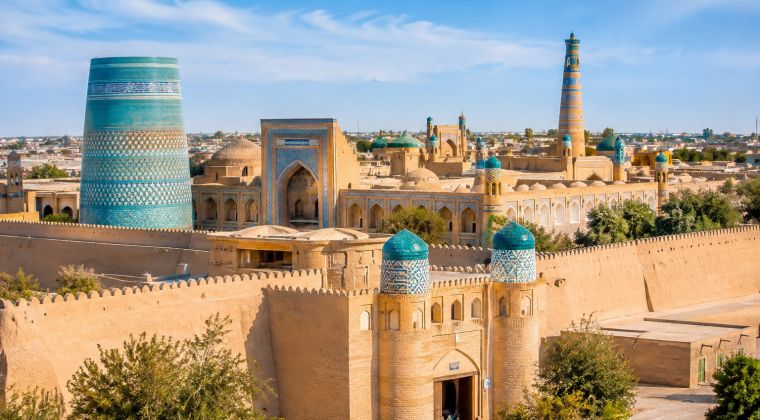
After meeting the guide, your acquaintance with Ichan-Kala begins — the historic center of Khiva, which, thanks to its superbly preserved architecture, has gained the status of an open-air museum and been included in the UNESCO World Heritage List.
Behind the mighty fortress walls is hidden a remarkable world of Eastern architecture: old madrasas, mosques, minarets, palaces and narrow streets that have preserved the atmosphere of a medieval city.
The tour will begin at the Ata-Darvaza gate. Next you will see the famous Kalta-Minor, an unusual minaret that stands out for its massive shape and bright majolica finish. Nearby is the Muhammad Amin Khan madrasa, one of the largest historic religious educational institutions in Khiva.
The route will continue with Kunya-Ark, an ancient citadel that served as the residence of the Khivan khans. Behind its walls were palace rooms, inner courtyards and administrative buildings. Then you will visit the madrasa of Muhammad Rahim Khan, named after the ruler who was also known as the poet and thinker Feruz.
A special place in the program is occupied by an introduction to traditional carpet weaving. You will visit a workshop created as part of a project with the participation of Operation Mercy and UNESCO. The initiative is aimed at supporting local women craftsmen, preserving traditional technologies and developing the cultural heritage of the region. Here you will be able to see how the famous Khivan carpets are made by hand, learn about the features of weaving and try working at a traditional loom yourself.
Next, the route will continue with a visit to the mausoleum of Pahlavan Mahmud, one of the most revered spiritual monuments of the city. You will also see the Islam Khoja madrasa and minaret, and then proceed to the Juma Mosque, famous for its unusual interior and numerous wooden columns with artful carving.
The next stop will be the Tash-Hauli palace, the former residence of the Khivan rulers. Its inner courtyards, decorative elements and richly decorated rooms, including the famous harem, make it possible to imagine the features of court life in an Eastern khanate.
The program also includes the madrasa and caravanserai of Allakuli Khan, as well as the Said Niyaz Shalikar mosque.
The tour will conclude with a visit to the Silk Museum. Here you will become familiar with the traditions of producing and dyeing silk fabrics, and will also be able to take part in the dyeing process yourself.
After the tour, free time is provided. You will be able to stroll independently around the historic center, look into craft shops or rest after a busy day.
During the tour the guide will also tell you about the ancient fortresses of Khorezm, which you will be able to visit the next day accompanied by a driver.
Overnight at a hotel in Khiva.
After breakfast you will set off for the archaeological monuments of ancient Khorezm. Today's route will let you see Uzbekistan from another side — not only as a country of magnificent cities, but also as a territory where unique civilizations developed over millennia.
The first part of the trip will be devoted to the fortresses of Ayaz-Kala and Toprak-Kala. They are located amid the open spaces of the Kyzylkum desert and are impressive archaeological monuments of ancient Khorezm. The distance to the visiting area is about 100 km, and the road takes approximately two hours one way.
Ayaz-Kala — a complex of ancient fortifications that have preserved traces of the region's defensive architecture. The history of these structures is connected with the Kushan period and earlier stages of Khorezm's development. The remains of fortress walls and towers make it possible to imagine what the defensive systems of ancient settlements looked like.
Toprak-Kala — one of the most significant archaeological sites of ancient Khorezm. In the 3rd century AD a large political and cultural center stood here. Among the ruins you can see traces of the ancient city layout and imagine the scale of the once-flourishing settlement.
Visiting these monuments will be a real journey into the past. Far from the usual city bustle, amid desert landscapes, you will become acquainted with the history of states and peoples that existed long before the formation of modern Uzbekistan.
After the tour is completed, a car transfer to Bukhara will begin. The distance is about 450 km, and the travel time is approximately 6–7 hours.
The road will pass through the steppe and desert territories of the Kyzylkum. Stops are planned along the way for rest and photography.
Upon arrival in Bukhara, check-in at the hotel will take place. The remaining time can be devoted to rest or an independent walk around the city.
Overnight at a hotel in Bukhara.
Today an introduction to Bukhara awaits you — an ancient city that for many centuries was one of the most important centers of the Great Silk Road. Trade, crafts, science and religious culture developed here, and numerous historical monuments have preserved the unique look of the medieval East.
The tour will begin with the Chashma-Ayub mausoleum, also known as “Job's Spring.” According to local legends, the story of the prophet Ayub is connected with this place. On the territory of the complex is a revered spring that attracts both pilgrims and travelers.
Then you will visit the mausoleum of Ismail Samani, one of the most valuable architectural monuments of the 10th century. It is an outstanding example of early Islamic architecture, famous for its artful brickwork and complex geometric patterns. The mausoleum also serves as the burial place of members of the ruling Samanid dynasty.
The next stop will be the Bolo-Hauz mosque, known for its tall wooden columns and graceful iwan. Its architectural design harmoniously complements the historic ensemble of old Bukhara.
Next you will go to the Ark fortress, an ancient citadel that for centuries was the residence of the Bukharan emirs. Behind its massive walls were palaces, administrative rooms and other buildings connected with the governing of the state. From the fortress grounds, interesting views of the historic center of the city open up.
The route will continue with the Lyabi-Hauz ensemble, one of the coziest and most recognizable places in Bukhara. At the center of the architectural complex is an old pond surrounded by madrasas and other historic buildings. For centuries the square remained an important place for meetings, relaxation and the public life of the townspeople.
Then a walk awaits you through the old trading domes: Toki Telpak-Furushon, Toki Zargaron and Toki Sarrafon. In the past, here were located the shops of merchants of fabrics, jewelry, ornaments and other goods that were brought to Bukhara from all over the East.
You will also visit the Magoki-Attori mosque, built on the site of an ancient Zoroastrian temple. This monument is especially interesting because it reflects different historical and religious periods in the development of the city.
A special event of the day will be an introduction to the national cuisine. In a local home, a master class on preparing Uzbek plov awaits you. You will be able to see the traditional process of preparing the main dish of the Uzbek feast, learn about the choice of ingredients and take part yourself in the culinary master class.
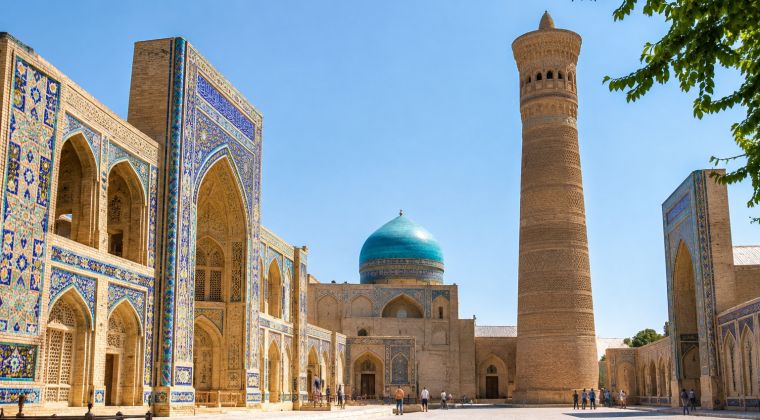
After lunch the tour will continue with a visit to the Poi-Kalyan ensemble, one of the main architectural symbols of Bukhara. The complex combines the majestic Kalyan mosque with its tall minaret and the Mir-i-Arab madrasa.
To conclude the program, you will become acquainted with the madrasas of Ulugbek and Abdulaziz Khan, monuments demonstrating the development of architecture, education and decorative art in different historical eras.
After the tour, return to the hotel.
After breakfast, the program will continue with an introduction to the surroundings of Bukhara. This day is devoted to the spiritual heritage of the region, the history of Sufi traditions and the architecture of the country residences of the Bukharan rulers.
The first stop will be the Chor-Bakr necropolis, one of the well-known memorial complexes of the region. This place has great spiritual significance and is connected with the history of religious figures and the Naqshbandi Sufi tradition. On its territory are mausoleums, mosques and other historic structures that create a special atmosphere of silence and tranquility.
Then you will visit the memorial complex of Bahauddin Naqshband, an important spiritual center dedicated to an outstanding Sufi teacher. Here are his mausoleum, a madrasa and other religious buildings. For many centuries the complex has remained a place of pilgrimage for followers of the Sufi teaching and for all who are interested in the spiritual history of Central Asia.
The next point on the route will be the Sitorai Mohi-Hosa palace, the summer residence of the last Bukharan emir. Its poetic name translates as “The Palace Where the Moon and the Stars Meet.”
The architectural ensemble is an unusual combination of Eastern traditions and European elements. Luxurious interiors, decorative painting, mirrors, fountains and well-kept gardens reflect ideas of comfort and beauty characteristic of the ruling elite of the Bukharan Emirate.
A visit to the palace will let you learn about the history of the last years of the emirate and imagine how the life of the rulers was organized at the beginning of the 20th century.
In the second half of the day you will return to Bukhara. The remaining time will be free. We recommend devoting it to a walk through the old quarters, visits to local workshops and getting acquainted with the work of craftsmen who continue to preserve the traditions of weaving, ceramics and other folk crafts.
Overnight at a hotel in Bukhara.
After breakfast and check-out, you will set off on a journey through the historical and natural corners of Uzbekistan. Today an introduction awaits you to traditional ceramics, ancient fortresses, sacred springs and the unusual atmosphere of a desert yurt camp.
The first stop will be Gijduvan, one of the best-known centers of ceramic art in the country. The history of the local pottery craft spans several centuries, and the characteristic ornaments and painting techniques have become widely known far beyond the region.
Here you will visit the workshop of the hereditary potters of the Narzullaev family. The masters will introduce you to traditional methods of making ceramics, show the main stages of working with clay and tell how the secrets of the craft are passed from older generations to younger ones.
Next the route will continue with a trip to the area of the village of Sarmyshsay. This area attracts travelers with its natural landscapes, desert valleys and traces of ancient oases. Here you can take beautiful photographs, enjoy the calm of the surrounding nature and observe the daily life of local residents.
The next stop is Nurata, a city with a rich history and many local legends. Here you will visit the ruins of the fortress of Alexander the Great, which is traditionally associated with defensive structures of the 4th century BC. According to historical understanding, such fortifications had strategic importance for controlling trade routes and caravan routes.
Then you will become acquainted with the Chashma complex, a well-known place of pilgrimage, the center of which is a sacred spring. Its waters are considered healing, and numerous local legends are connected with the origin of the spring.
In the second half of the day a transfer will take place to a yurt camp located in the Kyzylkum desert not far from Lake Aydarkul. The road from Nurata will take approximately 3–4 hours, and the distance is about 240 km.
Upon arrival, accommodation awaits you in traditional yurts — dwellings that were used for centuries by the nomadic peoples of Central Asia. It is a special experience that lets you leave the usual city rhythm for a while and feel the space and silence of the desert.
In the evening the program will continue with an introduction to the traditions of nomadic life. A gathering by the campfire, the preparation of national dishes and a culinary master class await you. Such activities will help you get closer to the culture of local residents, their way of life and traditions.
The organization of the stay at the camp is oriented toward ecological recreation and a careful attitude toward the natural environment.
Breakfast at the yurt camp.
Departure from the camp toward Lake Aydarkul is planned. For those who wish to greet the sunrise over the desert, an earlier departure is possible, to see how the first rays of the sun gradually light up the sandy expanses and the water surface.
Lake Aydarkul is one of the most unusual natural places in Uzbekistan. Its calm waters contrast with the surrounding desert landscapes, creating a remarkable picture amid the boundless expanses of the Kyzylkum.
Additionally, you can go for a camel ride across the sand dunes near the lake. It is an opportunity to touch the traditional way of life of nomadic peoples and to imagine how travelers in the past covered great distances across desert territories.
After getting acquainted with the natural beauty of the region, you will head to Samarkand. The car journey will take about 4–5 hours, and the distance is approximately 250 km.
Upon arrival, check-in at the hotel will take place. The remaining time can be spent independently.
In the evening we recommend a walk around Registan Square. After sunset the architectural ensemble is especially beautiful: the illumination emphasizes the elegant ornaments, domes and monumental portals of the three madrasas.
Overnight at a hotel in Samarkand.
After breakfast an introduction awaits you to the historic center of Samarkand — a city that for centuries was one of the most important cultural, trade and scientific centers of the Great Silk Road. It gained particular fame in the era of Amir Temur and his descendants, when majestic architectural ensembles were built here and the sciences and crafts developed.
The tour will begin at Registan Square, the main architectural sight of the city and one of the most recognizable historic ensembles of Central Asia.
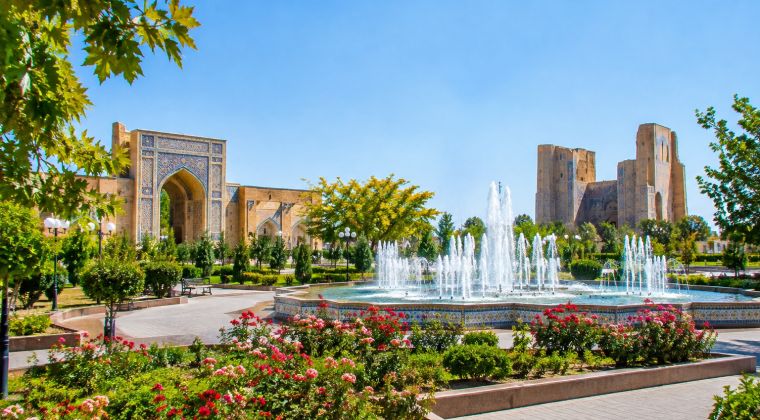
The square is surrounded by three famous madrasas. The first of them is the Ulugbek madrasa, built in the 15th century and connected with the era of the flourishing of science and education under Mirzo Ulugbek. The second is the Sherdor madrasa, known for the unusual decoration of its portal. The third is the Tilla-Kari madrasa, famous for its rich interior decoration and golden decorative elements.
Next you will visit the Gur-Emir mausoleum, the resting place of Amir Temur and members of the Timurid dynasty. It is one of the most significant monuments of Timurid architecture, which influenced the development of monumental architecture in many countries of the Islamic world.
The next stop will be the Bibi-Khanum mosque, a grand structure of the 15th century, built by order of Amir Temur. At the height of its glory the mosque was considered one of the largest in the region. Its massive portals, domes and decorative elements demonstrate the architectural ambitions of the Timurid era.
Nearby is the Siab Bazaar, the main trading market of Samarkand. Here you can get acquainted with the daily life of the city, taste traditional foods, and buy dried fruits, spices, Eastern sweets and the famous Samarkand flatbreads.
In the second half of the day you will go to the Shah-i-Zinda complex, a unique necropolis of the 14th–15th centuries, consisting of mausoleums connected with relatives and associates of the Timurid dynasty. The complex amazes with the variety of its architectural solutions, bright mosaic panels, majolica and delicate ornaments.
A special addition to the tour will be a master class on making traditional Uzbek bread. You will learn about the features of national bread baking, become acquainted with the traditions of making flatbreads and be able to take direct part in the process.
After the program is completed, return to the hotel. Free time.
Overnight at a hotel in Samarkand.
After breakfast, the introduction to the history of Samarkand will continue. Today the program will be devoted to archaeological discoveries, spiritual monuments and the traditional technologies thanks to which the city has been famous for many centuries.
The first site will be the Afrasiab Archaeological Museum, located on the territory of an ancient settlement that existed long before the Mongol invasion. The museum exhibition presents archaeological finds, household items and the famous frescoes of the 7th century. They give an idea of the cultural life of ancient Samarkand, its trade ties and contacts with other states.
Then you will visit the mausoleum of the Prophet Daniel — Khazrati Doniyor. This unusual spiritual place is revered by representatives of several religious traditions, including Muslims, Christians and Jews. Many legends and tales are connected with it, which have been passed down by local residents over the centuries.
Next the route will continue with a trip to the village of Konigil, where the “Meros” workshop is located — a center for preserving the old technologies of making Samarkand paper and silk.
Here you will be able to see how traditional masters work with natural raw materials, become acquainted with the main stages of production and follow the entire process of turning source materials into finished products. Visiting the workshop will let you learn more about the craft traditions of Samarkand and the history of the famous Samarkand paper, which in the past was known far beyond Central Asia.
The next point of the program will be the Ulugbek Observatory, founded in 1420. It is one of the most important scientific monuments of the medieval East. Under the leadership of Mirzo Ulugbek, large-scale astronomical research was carried out here, and the star catalog created by the scholars was considered one of the most accurate for its time.
A visit to the observatory will let you become acquainted with the scientific achievements of the Timurid era and see how significant a role Samarkand played in the development of world science.
After the sightseeing program, a transfer to the railway station will take place. Then you will go to Tashkent on the high-speed “Afrosiyob” train. The travel time will be about 2.5 hours.
Upon arrival in the capital you will be met and taken to the hotel.
Overnight at a hotel in Tashkent.
After breakfast, a sightseeing tour of Tashkent awaits you — the largest city of Uzbekistan, where historic quarters coexist with modern buildings, wide avenues and green public spaces.
The introduction to the city will begin with the Old City and a visit to the Hast-Imam complex, one of the main spiritual centers of the country. Here are concentrated important religious and historical monuments, including the Tilla-Sheikh mosque, the Barak Khan madrasa and the Muyi Mubarak museum.
During a panoramic introduction to the Center of Islamic Civilization, you will learn about the famous Quran of Caliph Uthman, one of the best-known ancient manuscripts of the Quran. According to historical tradition, traces of the blood of Caliph Uthman have been preserved on the pages of the manuscript.
Then you will go to the Chorsu bazaar, one of the most colorful markets of Tashkent. Its recognizable green dome has long become part of the city landscape. In the trading rows are displayed fresh fruits and vegetables, dried fruits, spices, sweets, baked goods and national dishes. Here you can feel the true rhythm of an Eastern city, get acquainted with local trading traditions and taste dishes of Uzbek cuisine.
The tour will continue with a ride on the Tashkent metro. Its stations are known for their unusual design, decorative panels, marble finishing and individual architectural solutions. Each of them has its own artistic character.
In the second half of the day you will get acquainted with the modern part of the capital. During the sightseeing drive, a visit to and viewing of the following sights is planned:
The sightseeing program will conclude with a visit to the Museum of Applied Arts. It is located in a historic building of the Soviet period, whose architecture is itself of interest.
The museum collection holds works of traditional Uzbek art: embroidered fabrics, carpets, ceramic items, jewelry and musical instruments. The exhibition introduces the variety of folk crafts, old technologies and decorative techniques, many of which continue to be used by modern masters.
After the tour is completed, a transfer to the hotel will take place.
Overnight at a hotel in Tashkent.
After breakfast, a transfer will take place to Tashkent International Airport to check in for the international flight.
Your journey through Uzbekistan is coming to an end. Over ten days you have become acquainted with the ancient history of Khorezm, strolled along the medieval streets of Khiva and Bukhara, seen the architectural grandeur of Samarkand, discovered the desert expanses of the Kyzylkum and touched the traditions of local craftsmen.
Uzbekistan will remain in your memory not only for its magnificent monuments, but also for the hospitality of its people, the aromas of Eastern cuisine, the beauty of its natural landscapes and the unique atmosphere of the Great Silk Road.
Transfer to the airport and flight home.


