


A journey through Uzbekistan is a chance to discover a remarkable blend of ancient history, Eastern architecture, distinctive traditions and extraordinary natural landscapes. Over eleven days you will get to know the cultural heritage of Khorezm, see the famous monuments of Bukhara and Samarkand, travel to the vanishing Aral Sea and discover life in small Uzbek settlements.
Themes: Cultural, Historical, Adventure, Gastronomical tours, Religious ,
A journey through Uzbekistan is a chance to discover a remarkable blend of ancient history, Eastern architecture, distinctive traditions and extraordinary natural landscapes. Over eleven days you will get to know the cultural heritage of Khorezm, see the famous monuments of Bukhara and Samarkand, travel to the vanishing Aral Sea and discover life in small Uzbek settlements.
The itinerary brings together a wide range of experiences: walks through medieval cities, an introduction to traditional crafts, culinary discoveries, a night in the desert and encounters with the hospitality of local people. This journey will let you see Uzbekistan not only as a country of great historical monuments, but also as a place with remarkable nature, a rich culture and a special atmosphere.
Arrival at Urgench International Airport.
On arrival you will be met by a driver with a name sign, after which the drive to Nukus, the capital of the Republic of Karakalpakstan, will begin. The road, about 170 km long, takes approximately three hours.
Upon arrival, accommodation at a hotel and time to rest after the flight are provided. For the convenience of travelers, breakfast and early check-in are included in the program.
After resting, you will set off on an excursion to one of the most unusual cultural centers in Central Asia — the I. V. Savitsky State Art Museum. Thanks to its unique collection, the museum has earned the unofficial name “the Louvre in the Desert.”
Its collection is of special artistic value: it holds works by Russian avant-garde artists, many of whom were criticized and persecuted during the Soviet period. The museum also has a rich collection of traditional art from Karakalpakstan and other regions of Central Asia.
During the tour, a specialist will tell you about the history of the museum's creation, the fates of the artists and the most interesting exhibits in the collection. Please note that guided tours directly inside the museum are provided in English.
The first part of the journey proceeds at a relaxed pace, so that you have enough time to recover and prepare for the upcoming expedition to the Aral Sea area.
Overnight at a hotel in Nukus.
Breakfast.
In the morning you will leave Nukus and head toward Muynak, a town that was once one of the major fishing ports on the shore of the Aral Sea. Today this place has become one of the most vivid symbols of the ecological disaster that changed an entire region.
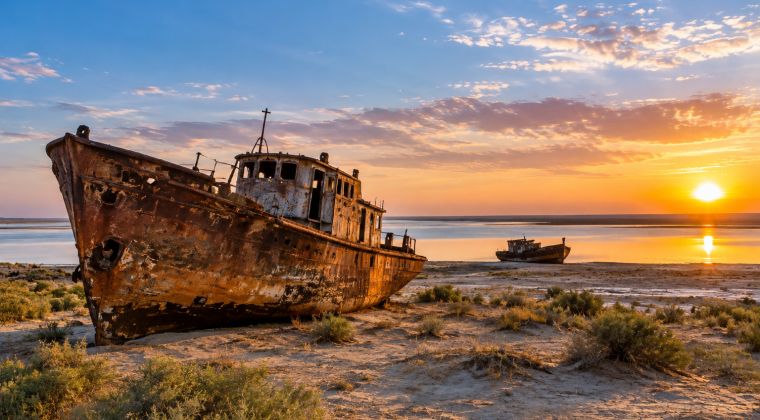
The first stop will be the famous Ship Graveyard. Here, on the former seabed, lie fishing vessels left stranded far from the present-day shoreline. Their hulls recall a time when Muynak was a thriving port town and the life of the local population was closely tied to the sea.
Then you will visit the Muynak local history museum, where you will learn about the history of the town, the fishing industry and the changes that have taken place in the region. Watching a short documentary will help you better understand the scale of the ecological and social transformations that occurred.
After lunch at a guesthouse, the journey will continue across the dried-up seabed. Ahead lies the road to the Ustyurt Plateau, one of the most impressive natural areas of Uzbekistan.
Along the way there are stops at scenic viewpoints and ancient burial sites of nomadic peoples. The landscapes gradually change: wide desert expanses, deep depressions and majestic cliffs of the plateau will open up before you.
The panoramic views from the heights of Ustyurt make a particular impression, where the harsh beauty of the desert creates a sense of endless space.
Upon arrival at the shore of the Aral Sea, you will have free time to walk along the water, relax on the shore, swim or collect shells.
Toward evening you will head to a yurt camp located near a lake. Here an unusual night far from the bustle of the city awaits you. After dinner you can spend time by the campfire, admire the starry sky and enjoy the silence of the desert land.
Dinner and overnight at the yurt camp.
Important: the shower rooms and toilets are shared.
Breakfast at the yurt camp.
Begin the morning with one of the most atmospheric moments of the journey — watching the sunrise on the shore of the Aral Sea. The first rays of sun gradually light up the desert landscapes, creating a wonderful play of light and color. It is a great opportunity to enjoy nature and take memorable photographs.
After breakfast you will head back to Nukus. However, the return trip will become a continuation of your acquaintance with the history and little-known corners of Karakalpakstan.
The first stop will be Kurgancha-Kala, an ancient fortified settlement that existed in the 12th–14th centuries. In the past, such structures were of great strategic importance and served as strongholds on the trade routes of the Great Silk Road.
Next, the route passes through Kubla-Ustyurt, a small gas settlement that arose in the Soviet period. Here you will be able to see how life developed in one of the most remote areas of the region and learn about the history of how this settlement was formed.
The next part of the route will take you to an old lighthouse and the abandoned fishing village of Urga, located not far from Lake Sudochye. This area is of particular interest to nature lovers and bird watchers. The lake is an important stopover for migratory birds, among which you can see flamingos, pelicans and swans.
After lunch in Kungrad, the journey will continue with a visit to the Mizdakhkan necropolis, one of the best-known historical and spiritual complexes of Karakalpakstan.
On the territory of the ancient necropolis, mausoleums, religious structures and the remains of an old settlement have been preserved. Among the most significant monuments are the mausoleums of Nazlumkhan Sulu and Shamun Nabi, as well as the Gyaur-Kala archaeological complex. This place is surrounded by numerous legends and tales that give it a special atmosphere.
In the second half of the day you will arrive in Nukus.
Overnight at a hotel in Nukus.
After breakfast you will set off for Khiva, one of the best-preserved historic cities of Central Asia. For centuries this ancient city was an important point of caravan trade and a cultural center of the Khorezm oasis.
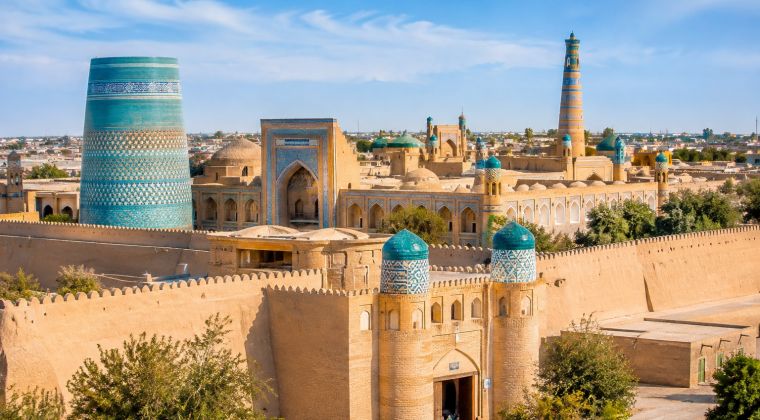
Upon arrival — check-in at the hotel and the start of the sightseeing program in Ichan-Kala. The historic center of Khiva is a unique architectural ensemble surrounded by fortress walls and included in the UNESCO World Heritage List.
Narrow paved streets, old madrasas, mosques, minarets and traditional residential houses create the impression of traveling back in time.
Your acquaintance with the city will begin at the Ata-Darvaza gate. Next you will see the famous Kalta-Minor, an unusual turquoise minaret that has become one of the main symbols of Khiva, and the Muhammad Amin Khan madrasa located next to it.
The next stop will be the Kunya-Ark fortress, the former residence of the Khivan rulers. Behind its massive walls are hidden inner courtyards, reception rooms and historic buildings. You will also visit the madrasa of Muhammad Rahim Khan II, known by his literary pseudonym Feruz.
A special part of the program is a visit to a workshop making traditional Khivan carpets. The project, created with the support of Operation Mercy and UNESCO, aims to preserve the local art of carpet weaving and to pass traditional skills on to new generations.
Here you will learn about the features of handmade carpet production, see the work of the masters and be able to try your hand at weaving yourself. Visiting the workshop will also introduce you to the principles of responsible tourism and the role of local communities in preserving cultural heritage.
Next, the tour continues with a visit to the mausoleum of Pahlavan Mahmud, one of the most revered architectural and spiritual monuments of Khiva. You will also see the Islam Khoja madrasa and minaret, and then proceed to the Juma Mosque, famous for its many wooden columns with elaborate carving.
An important place in the program is occupied by the Tash-Hauli palace complex, the luxurious residence of the Khivan khans with richly decorated inner courtyards, decorative elements and the famous harem.
After this you will get acquainted with the architectural ensemble of Allakuli Khan, which includes a madrasa and a caravanserai, and also visit the Said Niyaz Shalikar mosque.
The tour will conclude with a visit to the Silk Museum. Here you will learn about traditional methods of processing and dyeing silk fabrics, and will also be able to try giving the material a new shade yourself.
After the full excursion, you will have free time for independent walks around Ichan-Kala, buying souvenirs or relaxing in one of the local cafés.
The guide will also tell you about the ancient fortresses outside Khiva, which you can visit the next day with the driver.
Overnight at a hotel in Khiva.
In the morning you will leave Khiva and set off to explore the ancient archaeological sites of Khorezm. After about two hours on the road, you will find yourself amid the desert landscapes of the Kyzylkum, where impressive remains of old fortresses have survived.
The first point on the route will be Ayaz-Kala, a large archaeological complex consisting of several ancient fortifications. Its history is connected with the Kushan period and the development of the region's defensive architecture. The remains of fortress walls, located on a hill, make it possible to imagine how important a role such structures played in protecting ancient settlements and controlling the surrounding territories.
Then you will visit Toprak-Kala, one of the most important archaeological sites of ancient Khorezm, dating to the 3rd century. In its time it was a large administrative and cultural center connected with the history of the Khorezmian rulers.
Today the ruins of the ancient city make it possible to see the layout of the old settlement and become familiar with the features of pre-Islamic architecture.
Both fortresses are of special historical value and offer a chance to touch little-known pages of Central Asia's past.
After visiting the archaeological complexes, a long transfer to Bukhara will begin. The road, about 450 km long, will take approximately 6–7 hours.
The route passes through boundless steppes and the sandy expanses of the Kyzylkum desert. Rest stops are planned along the way.
By evening you will arrive in Bukhara, a city with a centuries-old history, famous for its mosques, madrasas, trading domes and the atmosphere of the old East.
Check-in at the hotel and free time after the road.
Overnight at a hotel in Bukhara.
Today marks the start of the tour of Bukhara.
Bukhara is one of the oldest cities of Central Asia, which for many centuries played an important role in the trade, science, culture and spiritual life of the region. Thanks to its rich architectural heritage and numerous historical monuments, the city is considered a true pearl of the Great Silk Road.
Your acquaintance with Bukhara will begin with the Chashma-Ayub mausoleum. This unusual historical structure is linked to the legend of the Prophet Job, who, according to tradition, struck the ground with his staff, after which a spring of water appeared here. Today the mausoleum attracts visitors not only with its architecture but also with its spiritual history.
Then you will go to the mausoleum of Ismail Samani, one of the most outstanding architectural monuments of the 10th century. It is distinguished by its unique brickwork, in which geometric patterns create a striking decorative design. The mausoleum is considered a true masterpiece of early Islamic architecture in Central Asia.
Next in the program are the Bolo-Hauz mosque, known for its graceful carved wooden columns, and the Ark fortress, an ancient citadel that for centuries served as the residence of the Bukharan rulers. Behind the fortress's massive walls were palace rooms, administrative buildings and various utility structures.
The walk will continue with a visit to the Lyabi-Hauz ensemble, one of the coziest and most atmospheric places in old Bukhara. The central element of the complex is an artificial pond, around which historic madrasas and old buildings are arranged. For centuries this square remained an important place for meetings, trade and relaxation for the townspeople.
Then you will stroll through Bukhara's famous trading domes: Toki Telpak Furushon, Toki Zargaron and Toki Sarrafon. In the past, under these vaults were the workshops and shops of craftsmen, jewelers and merchants. Today you can buy handmade goods, textiles, jewelry and traditional souvenirs here.
You will also visit the Magoki-Attori mosque, built on the site of an ancient religious structure, which makes it a particularly interesting monument from the point of view of the history of religion and architecture.
Lunch and culinary master class.
In the middle of the day, an introduction to Uzbek cuisine awaits you in the home of local residents. You will take part in preparing the national plov, one of the best-known dishes of the country.
During the master class, the hosts will share tips on choosing ingredients, cooking secrets and the traditions of serving this dish. It is a great opportunity not only to taste authentic home cooking but also to get closer to the everyday culture of an Uzbek family.
After lunch the tour will continue with a visit to the Poi-Kalyan architectural complex, one of the most recognizable ensembles of Bukhara. Its main adornment is the majestic Kalyan minaret, which for centuries served as a landmark for travelers and caravans.
The complex also includes the Kalyan mosque and the Mir-i-Arab madrasa. Next you will see the madrasas of Ulugbek and Abdulaziz Khan, monuments that demonstrate the development of architectural and decorative traditions of different eras.
In the second half of the day you will go outside the historic center to visit the summer residence of the last Bukharan emir — Sitorai Mohi-Hosa. The name of the palace translates as “The Palace Where the Moon Meets the Stars.”
The architecture of the residence is an interesting combination of Eastern traditions and European elements. Rich interiors, elegant finishing, decorative halls, fountains and well-kept gardens make it possible to imagine the luxurious life of the Bukharan court at the beginning of the 20th century.
After the tour — return to the hotel.
Overnight at a hotel in Bukhara.
Today a journey awaits you through the small towns and rural settlements of Uzbekistan, where the traditions of folk crafts and the familiar way of life have been especially well preserved.
After leaving Bukhara you will head to Gijduvan, a town known for its centuries-old pottery school. Local ceramics are distinguished by characteristic ornaments, rich colors and a special handmade technique.
Here you will visit the workshop of the hereditary potters of the Narzullaev family. Members of this family have preserved the traditions of Gijduvan ceramic art for several generations.
During your visit to the workshop you will be able to see the main stages of creating ceramic items: preparing the clay, shaping the objects, applying ornaments and decorative painting. It is a great opportunity to get acquainted with a craft that remains an important part of the region's cultural identity.
Next the route continues toward Nurata, a historic town located at the foot of the Nuratau mountains.
Here you will visit the remains of an ancient fortress traditionally associated with the name of Alexander the Great. It is believed that the fortification was built in the 4th century BC and had strategic importance for controlling the surrounding territories and trade routes.
The next stop is the sacred Chashma complex, known for its spring and a place of pilgrimage. Numerous local legends are connected with the water of this spring, and the complex itself occupies an important place in the spiritual life of the region.
The tour of Nurata is led by an English-speaking guide.
After getting acquainted with the town you will continue on to the village of Sentyab, a small mountain settlement that has preserved the traditional look of an Uzbek village.
Here time seems to flow more slowly: among the mountain slopes are houses of clay and stone, small vegetable gardens and orchards. Local residents continue to lead a traditional rural way of life, preserving familiar forms of farming and hospitality.
Upon arrival you will stay at the guesthouse of a local family. In the evening you will have the opportunity to stroll around the village, meet its residents, learn about their daily life and try your hand at preparing traditional dishes.
The special feature of this stop is the opportunity to see Uzbekistan beyond the popular tourist routes — through contact with local people, home cooking and the surrounding nature.
Dinner and overnight at the guesthouse of a local family.
The morning in Sentyab can be devoted to a leisurely walk around the surroundings. If you wish, you can walk along mountain paths, admire the natural scenery and take photographs of traditional rural architecture.
Departure for Samarkand.
The drive to one of the best-known historic cities of Uzbekistan will take about 3–4 hours.
For many centuries Samarkand was a major center of trade, science and culture on the Great Silk Road. The city became especially famous in the era of Amir Temur, when it became the capital of a vast empire and turned into one of the largest architectural centers of the East.
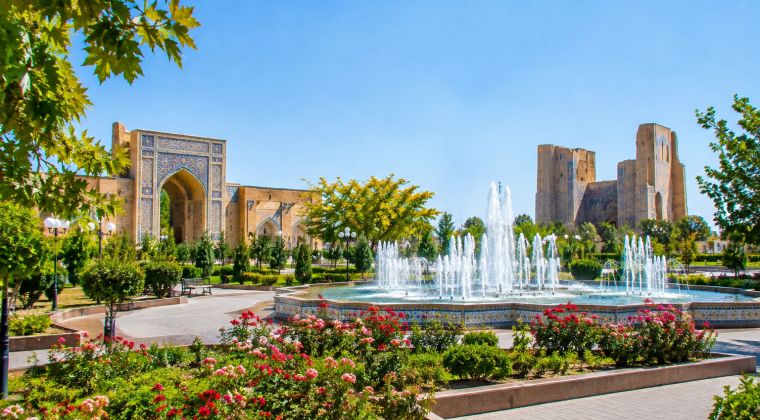
The tour will begin with a visit to Registan Square, the main symbol of Samarkand. This majestic ensemble consists of three madrasas: Ulugbek, built in the 15th century, and Sherdor and Tilla-Kari, built in the 17th century.
Monumental portals, exquisite mosaic compositions, calligraphic inscriptions and traditional geometric ornaments make the square one of the most impressive architectural ensembles of Central Asia.
The next attraction will be the Gur-Emir mausoleum, the resting place of Amir Temur and members of his dynasty. The building is known for its majestic dome, rich interior decoration and harmonious architectural proportions. Its architectural solutions influenced the development of mausoleum architecture in many countries of the Islamic world.
Next you will visit the Bibi-Khanum mosque, a grand monument of the 15th century, the construction of which was associated with the name of Amir Temur. At the height of its glory it was considered one of the largest mosques in the region and amazed contemporaries with its scale and the richness of its decoration.
Next to the mosque is the Siab Bazaar, one of the liveliest markets in Samarkand. Here you can get acquainted with local trading traditions, taste national sweets, and buy dried fruits, spices, nuts and the famous Samarkand flatbreads.
In the second half of the day the tour will continue with a visit to the Shah-i-Zinda necropolis. This unique architectural complex of the 14th–15th centuries consists of a whole series of mausoleums decorated with exquisite majolica, mosaics and glazed ceramics.
Each structure has its own decorative design, thanks to which a walk through the complex turns into an introduction to the true history of Eastern architectural art.
A special part of the program will be a master class on making Samarkand flatbread. You will get acquainted with the traditions of local bread baking and learn about the features of preparing the dough and baking bread in a traditional oven.
After the end of the sightseeing program — transfer to the hotel and check-in.
Free time for rest or independent walks around the city.
Overnight at a hotel in Samarkand.
Today you will continue getting to know the historical heritage of Samarkand, paying attention to monuments located outside the main tourist center.
After breakfast you will go to the Afrasiab archaeological museum, located next to the territory of the ancient settlement. Afrasiab is considered one of the most important archaeological sites in the region and preserves evidence of the existence of ancient Samarkand before the Mongol conquest.
The museum exhibition presents archaeological finds, household items, historical artifacts and the famous frescoes of the 7th century. Of particular interest is the reconstruction of the ancient city, which makes it possible to imagine its original layout and scale.
Then you will visit the mausoleum of the Prophet Daniel (Khazrat Doniyor), a revered religious site that is significant to several spiritual traditions at once. Numerous legends are connected with this complex, and the mausoleum itself has long remained a place of visit for pilgrims of various faiths.
The next stop will be the village of Konigil, where the “Meros” workshop is located. It is a well-known craft center engaged in reviving the traditional technology of making Samarkand paper.
During your visit you will learn about the history of local paper production and see how paper is made from natural raw materials using an old technology. Here you can also learn about the traditions of making silk and other handicrafts.
The tour program will conclude with a visit to the Ulugbek Observatory, founded in the 15th century by the outstanding ruler and scholar Mirzo Ulugbek.
In its time the observatory was one of the most important scientific centers of the East. It was here that large-scale astronomical observations were carried out and the famous star catalog was compiled, which was highly accurate for its era.
After the tour you will head to the railway station.
Departure for Tashkent on the high-speed “Afrosiyob” train.
The journey takes about 2.5 hours. During the trip you will be able to rest after the busy sightseeing days and enjoy the scenery opening up outside the train windows.
Upon arrival in the capital you will be met by a driver and taken to the hotel.
Overnight at a hotel in Tashkent.
Today will be devoted to getting to know Tashkent, the modern capital of Uzbekistan, where historic quarters coexist with wide avenues, modern buildings and green urban spaces.
The tour will begin with the Old City and the Hast-Imam complex, one of the most important religious and historical centers of the country. The architectural ensemble includes the Tilla-Sheikh mosque, the Barak Khan madrasa and the Muyi Mubarak museum.
Here you will learn about the history of Islamic education and the spiritual culture of the region, and also about the famous Uthman Quran, one of the oldest manuscripts of the Quran, kept in the museum's collection.
Next, the program includes a general visit to the Center of Islamic Civilization, dedicated to the historical, scientific and cultural heritage of the Islamic world and the contribution of Central Asian scholars.
After getting acquainted with the historic part of the city, you will go to the Chorsu bazaar, one of the best-known Eastern markets of Tashkent. It is easy to recognize by its large green dome, under which are trading rows with food products, spices, sweets and national dishes.
A walk through the bazaar will let you feel the true rhythm of Eastern trade, get acquainted with local products and, if you wish, try traditional Uzbek treats.
Then a ride on the Tashkent Metro awaits you. The capital's metro is known not only for its transport function but also for the artistic design of its stations. Each of them has its own architectural look, decorative panels, mosaics and elements of national design.
Getting to know the modern part of Tashkent.
In the second half of the day the route will continue with a sightseeing tour of the central squares and main city sites.
You will see:
The viewing of the modern part of the capital is carried out in a general overview format, which will give you a general idea of Tashkent's architecture and city life.
To conclude the tour you will visit the Museum of Applied Arts, located in a historic building with beautiful architectural design.
The museum presents the rich heritage of Uzbek masters. Its collection includes traditional embroidered fabrics, carpets, ceramics, jewelry, decorative items and musical instruments.
The exhibition allows you to trace the development of folk crafts and become acquainted with techniques that continue to be used by masters in different regions of the country.
After a full day of sightseeing — return to the hotel.
Overnight at a hotel in Tashkent.
The last morning of the journey can be spent in a relaxed atmosphere, enjoying breakfast and getting ready before the trip home.
Transfer to Tashkent International Airport.
This concludes your eleven-day journey through Uzbekistan and the Aral Sea region — a land of ancient cities, impressive architectural monuments, boundless deserts and remarkable cultural traditions.
You take home not only photographs of famous sights, but also memories of meetings with local people, Eastern cuisine, old crafts and the extraordinary nature of Central Asia.
Until we meet again in Uzbekistan!


