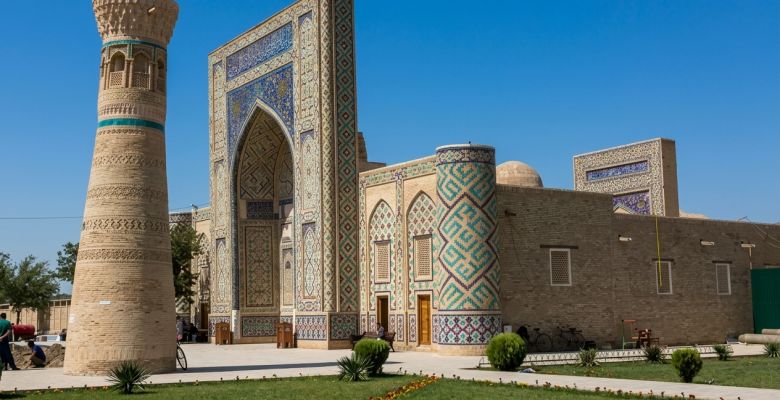
Among Gijduvan’s historical attractions, a special place belongs to the madrasah built by order of Mirzo Ulugh Beg, a ruler of the Timurid era who was also renowned for his scientific work in mathematics and astronomy. This educational institution was the third madrasah built by Ulugh Beg in Transoxiana. The first two were established in Bukhara and Samarkand.
Unlike the famous Ulugh Beg madrasahs in these two cities, the Gijduvan monument is not among the most frequently visited tourist attractions. Nevertheless, it is of considerable interest to travellers who want to explore the history of the Bukhara region and the cultural heritage of Central Asia in greater depth.
History of Construction
The madrasah in Gijduvan was built in 1437. Although it is considerably smaller than the major architectural complexes of Samarkand and Bukhara, its modest size does not make it any less impressive. The building features carefully designed proportions, a harmonious combination of architectural details, and rich decorative elements.
Originally, the madrasah served an educational purpose. Students studied religious subjects and various other fields of knowledge there. The very presence of such an educational institution in Gijduvan demonstrates the importance of education in the region’s cultural life during Ulugh Beg’s reign.
Architectural Features
One of the monument’s distinctive characteristics is its layout. The Gijduvan Madrasah belongs to the two-ayvan architectural type. The building includes two large ayvans, which are vaulted spaces characteristic of traditional Central Asian architecture.
The complex contained rooms intended for different purposes. These included a mosque, where prayers were held, and a darskhana, a special room used for lessons and student instruction.
Despite the building’s compact size, its architects managed to create an expressive and harmonious ensemble. Glazed bricks, majolica, and coloured ceramic tiles were used in the decoration. The variety of colours and ornamental motifs highlights the distinctive features of Central Asian architectural traditions.
The decoration does not overwhelm the building. Instead, it emphasises its proportions and individual architectural elements. Thanks to the artisans’ work, the madrasah has retained its distinctive appearance, allowing visitors to appreciate the construction and artistic skills of the fifteenth century.
The Madrasah and the Era of Ulugh Beg
The monument’s significance extends far beyond its architecture. Its history is directly connected with a period when education, scientific research, and culture were developing actively in Central Asia.
Mirzo Ulugh Beg is remembered not only as a ruler but also as a scholar. Astronomy held a particularly important place among his interests. He supported the development of education and helped establish educational centres where knowledge became an essential part of social and cultural life.
The Gijduvan Madrasah demonstrates how the major educational initiatives of the Timurid era extended beyond the region’s largest cities. Smaller towns also became part of Transoxiana’s educational and scientific landscape.
Why Include the Madrasah in Your Travel Itinerary?
Ulugh Beg Madrasah can conveniently be visited during a trip from Bukhara to Gijduvan. Exploring the monument can be combined with a walk around the town, visits to traditional pottery workshops, and an introduction to Gijduvan’s famous ceramics.
The attraction is especially interesting for those who enjoy Central Asian history, architecture, the development of science and education, and the heritage of the Timurid era.
Gijduvan’s compact size makes it possible to include the madrasah in a day trip and combine the visit with other interesting sites in the town.
The Mystery of Gijduvan Madrasah
Ulugh Beg Madrasah serves as a reminder of a time when the development of education and science was an important part of the cultural policies of Central Asian rulers. At the same time, the story of its establishment in Gijduvan leaves room for questions.
Why did Ulugh Beg choose Gijduvan as the location for his third educational institution? What role did the town play in the educational and cultural life of the region during the fifteenth century? These questions can become a separate part of an excursion and offer a new perspective on Gijduvan—not only as a centre of traditional ceramics but also as a town with a rich historical past.
Today, Ulugh Beg Madrasah remains one of the monuments connecting modern Gijduvan with the Timurid era and the centuries-old history of education in Central Asia.