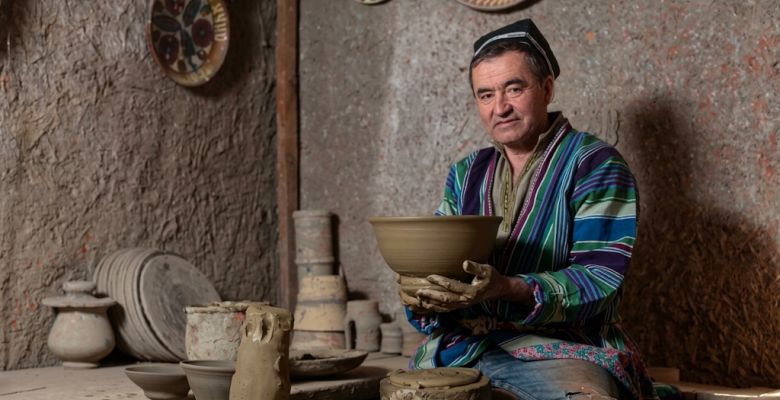
In Gijduvan, there is a place where discovering Uzbekistan’s traditional culture becomes a journey through time. Here, an ancient craft continues to exist not as a museum exhibit but as part of everyday life. This is the workshop of the Narzullayev family, a dynasty of hereditary potters dedicated to preserving and developing the Gijduvan school of ceramics.
The Traditions of Gijduvan Ceramics
Pottery has a centuries-old history in Gijduvan. The craft developed alongside the town itself and was passed down from one generation of artisans to the next over many centuries.
The Narzullayev family is one of the well-known families continuing this tradition. The head of the family, Ibodullo Narzullayev, and his sons, Alisher and Abdullo, have spent many years producing traditional ceramics.
For these artisans, pottery is not simply a way to earn a living or produce souvenirs. Each item is handmade and requires considerable time, attention, and professional experience. Their work is distinguished by characteristic patterns, expressive colours, and the recognisable style of the Gijduvan school.
The Narzullayev family’s creations have been displayed at international exhibitions on numerous occasions and have earned recognition from both art specialists and people interested in traditional crafts.
What Can Tourists Expect at the Workshop?
A special complex has been established at the workshop to allow visitors to explore ceramic art more closely. It combines a production workshop, a museum exhibition, and a showroom.
The museum displays a variety of traditional Uzbek ceramic products. Visitors can see piyalas (traditional drinking bowls), serving dishes, teapots, large platters known as lyagans, and other items of national tableware. Many pieces demonstrate the distinctive features of local decorative art and allow visitors to examine the patterns and techniques used by Gijduvan artisans.
However, visitors are often more interested in seeing the actual process of creating ceramics than in viewing the finished products.
Ceramics Up Close
The workshop offers demonstrations during which professional potters show visitors the main stages of ceramic production.
Visitors can watch an ordinary lump of clay gradually take the shape of a future object. The piece then undergoes the necessary stages of processing, drying, and firing. The final stage is decorative finishing, which involves applying traditional patterns and glaze.
This introduction to pottery helps visitors understand how much manual work goes into an everyday object such as a piyala or a jug. Every detail is created by the artisan, meaning that even two similar-looking pieces may have their own distinctive features.
The opportunity to do more than simply observe a potter at work is particularly appealing. Under the guidance of an experienced master, visitors can try making a small object themselves, creating their own piyala or another ceramic souvenir.
The finished piece can be kept as a reminder of a journey through Uzbekistan. Such a gift is especially valuable because its story begins with the traveller’s own hands.
Why Visit the Narzullayev Workshop?
Visiting the Narzullayev workshop offers an opportunity to experience Uzbekistan’s traditional culture in a living, interactive setting. Visitors can learn about the history of Gijduvan ceramics, watch hereditary artisans at work, explore the museum and exhibition area, and try their hand at pottery.
It is particularly interesting to observe how craft knowledge is passed from older artisans to younger generations. Thanks to these family traditions, ancient techniques do not disappear but continue to develop and find their place in the modern world.
A visit to the workshop leaves a lasting impression not only because of the beautiful ceramic products. It also helps visitors feel the connection between the past and the present and understand how important traditional crafts remain to the town’s cultural identity.
Gijduvan ceramics are the result of centuries of experience, craftsmanship, and dedication. The Narzullayev workshop allows visitors to discover this history not in books or behind museum display cases, but directly through the work of the artisans themselves.